Tag: VR for Medical Students

  • New Peer-Reviewed Study Shows Human Anatomy VR Improves Learning in Head and Neck Anatomy

    New Peer-Reviewed Study Shows Human Anatomy VR Improves Learning in Head and Neck Anatomy

    As anatomy education continues to evolve, institutions are looking for tools that do more than simply look impressive. They need solutions that fit academic workflows, support student understanding, and show real results. A newly published peer-reviewed pilot study in Otolaryngology–Head and Neck Surgery journal offers promising evidence that Human Anatomy VR can do exactly that in one of the most complex areas of medical education: head and neck anatomy.

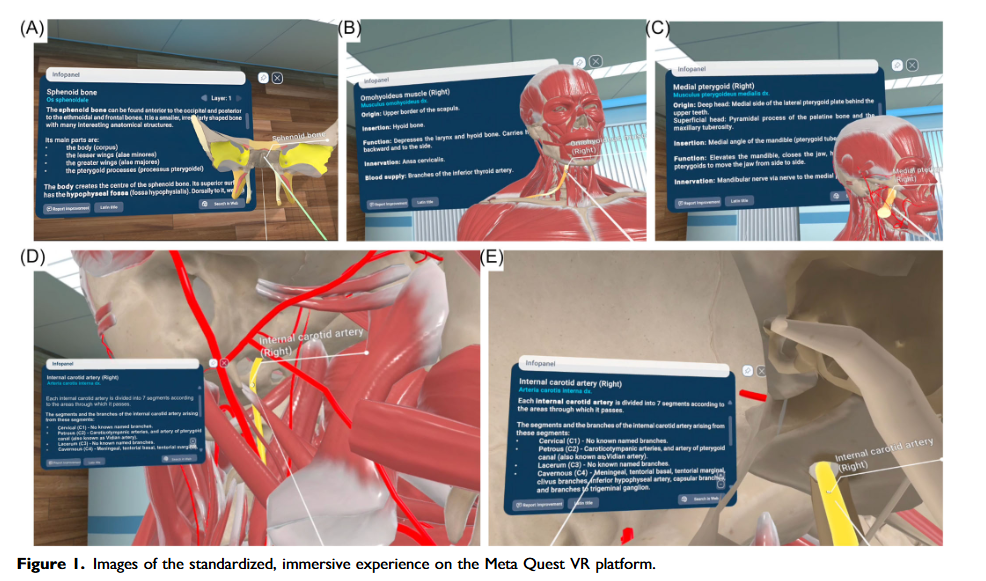
    In the study, “Next Dimension Medical Education: A Pilot Study Exploring Virtual Reality in Head and Neck Anatomy,” the authors evaluated a structured VR learning experience at Louisiana State University Health Shreveport. The educational platform used was Human Anatomy VR for Institutions on Meta Quest 3, with the authors creating a standardized instructional script for each participant.

    The study included 21 medical students who had already completed formal cadaveric anatomy education. Students first completed a multiple-choice quiz, then participated in a guided VR session, and finally completed a post-session quiz. The objective was to evaluate whether the VR intervention could improve understanding of head and neck anatomy, while also measuring confidence, satisfaction, and whether prior exposure to VR or gaming influenced outcomes.

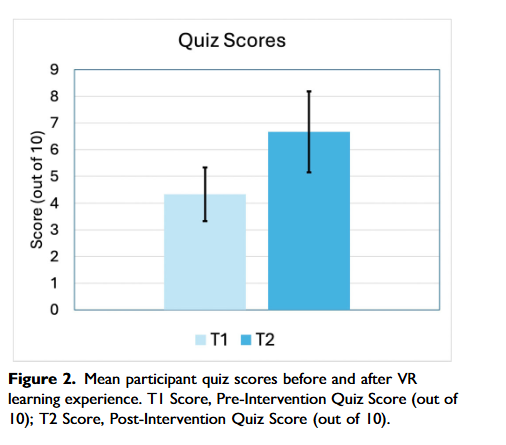
    The findings were impressive. Average quiz scores improved from 4.33 to 6.67 out of 10 after the VR session, an improvement in quiz scores of 54%. Just as importantly, the improvement was consistent regardless of whether students had prior experience with virtual reality or video games. In practical terms, that suggests the platform delivered educational value not only to tech-savvy users, but also to learners coming in with little or no immersive technology background.
    Student perception data also pointed in the same direction. The study reports that 90.48% of participants felt more confident in their head and neck anatomy knowledge after the experience. Students rated the VR session highly for control, sensory immersion, and realism, while reporting minimal distraction or frustration. For institutions evaluating new teaching tools, that combination matters. It is not enough for students to enjoy a platform. The platform also needs to feel intuitive, academically useful, and practical in a real learning environment. This study shows Human Anatomy VR can meet that standard.

    From an academic standpoint, one of the most valuable aspects of this publication is its realism. The students were not beginners to anatomy, and the VR session was not presented as a replacement for traditional teaching. Instead, the study supports a more credible and useful conclusion: Human Anatomy VR can serve as a high-value adjunct to existing anatomy education. That is exactly where many institutions see the greatest opportunity today, using immersive technology to reinforce spatial understanding, improve engagement, and give students access to repeatable 3D exploration outside the limits of conventional lab time.
    For medical schools, nursing programs, and health sciences faculties exploring the role of immersive learning, this study offers a practical signal. Human Anatomy VR is not only capable of creating an engaging experience. It can also contribute to better understanding, stronger confidence, and a more modern anatomy learning environment when integrated thoughtfully into curriculum.

    Study doi: https://doi.org/10.1002/oto2.70217

  • The Impact of Extended Reality at the University of Nevada

    The Impact of Extended Reality at the University of Nevada

    Revolutionizing Medical Education: The Role of Human Anatomy VR in the University of Nevada’s XR Integration

    At Virtual Medicine, we are proud to contribute to the transformation of medical education through Virtual Reality (VR). The recent study conducted by the University of Nevada, Las Vegas, highlights the significant role that Extended Reality (XR) technologies are playing in reshaping higher education, particularly in anatomy education. We are thrilled that our flagship platform, Human Anatomy VR, is part of this initiative, helping students and faculty at the University of Nevada explore the human body in an immersive way.

    Integrating VR in Higher Education

    The University of Nevada’s study explored the integration of VR/AR technologies in higher education, specifically focusing on the creation of immersive learning environments. The study outlines the systematic implementation of XR technologies, including the establishment of dedicated VR spaces like the Innovation Studio and agnostic VR/AR classrooms. These spaces were designed to support faculty research, software development, and interdisciplinary collaboration.

    One of the core aspects of this initiative was the faculty cohort program, which encouraged faculty members across disciplines to adopt XR technologies in their curricula. This program aimed to enhance student engagement, foster collaboration, and explore innovative teaching methods through immersive learning.

    How Human Anatomy VR is Supporting the University of Nevada’s Efforts

    In the context of the University of Nevada’s immersive learning initiative, Human Anatomy VR has been a key tool in enhancing the delivery of anatomy education. Our platform aligns perfectly with the goals set forth in the study, providing students with an interactive and engaging way to explore anatomical structures in 3D.

    • Interactive Learning: As the study highlighted, VR enhances student engagement by allowing them to interact with complex anatomical structures. Human Anatomy VR enables students to manipulate over 13,000 detailed anatomical structures, providing a more hands-on learning experience than traditional methods. This feature helps students at the University of Nevada visualize and interact with body systems, deepening their understanding of anatomy.
    • Support for Multi-Disciplinary Collaboration: The study emphasizes the importance of interdisciplinary collaboration, and Human Anatomy VR supports this by enabling multi-user modes. Students and faculty can collaborate in real-time within a virtual classroom, explore anatomical models together, and discuss various physiological processes. This collaborative aspect has been crucial in the University of Nevada’s efforts to integrate VR into their curricula across different disciplines.
    • Flexible Learning Environments: The University of Nevada has developed XR classrooms that support large-scale immersive learning. Human Anatomy VR has been integrated into these classrooms, allowing for real-time, interactive learning sessions that are accessible to students regardless of their location. This aligns with the study’s goal of creating scalable immersive learning environments that can be used in medical education and beyond.
    Impact on Students and Faculty: Enhancing Learning Outcomes

    The University of Nevada study also evaluates the effectiveness of VR tools in improving student outcomes. Human Anatomy VR has directly contributed to this success by offering a platform where students can engage in hands-on, immersive learning. Studies have shown that students using Human Anatomy VR experience significant improvements in knowledge retention, engagement, and understanding of complex anatomical concepts.

    Moreover, the platform’s ability to break down complex structures into interactive 3D models has made anatomy more accessible and engaging for students, further validating the findings of the University of Nevada’s study, which indicates that VR tools can enhance experiential learning.

    Looking Ahead: The Future of VR in Education

    The University of Nevada’s study showcases the growing integration of VR/AR technologies in education, with a focus on creating immersive learning environments that can support interdisciplinary collaboration and improve student engagement. Human Anatomy VR is proud to be a part of this effort, providing a solution that aligns with the university’s vision of making anatomy education more interactive, accessible, and effective.