
Tag: Immersive anatomy learning

  • New Peer-Reviewed Study Shows Human Anatomy VR Improves Learning in Head and Neck Anatomy

    New Peer-Reviewed Study Shows Human Anatomy VR Improves Learning in Head and Neck Anatomy

    As anatomy education continues to evolve, institutions are looking for tools that do more than simply look impressive. They need solutions that fit academic workflows, support student understanding, and show real results. A newly published peer-reviewed pilot study in Otolaryngology–Head and Neck Surgery journal offers promising evidence that Human Anatomy VR can do exactly that in one of the most complex areas of medical education: head and neck anatomy.

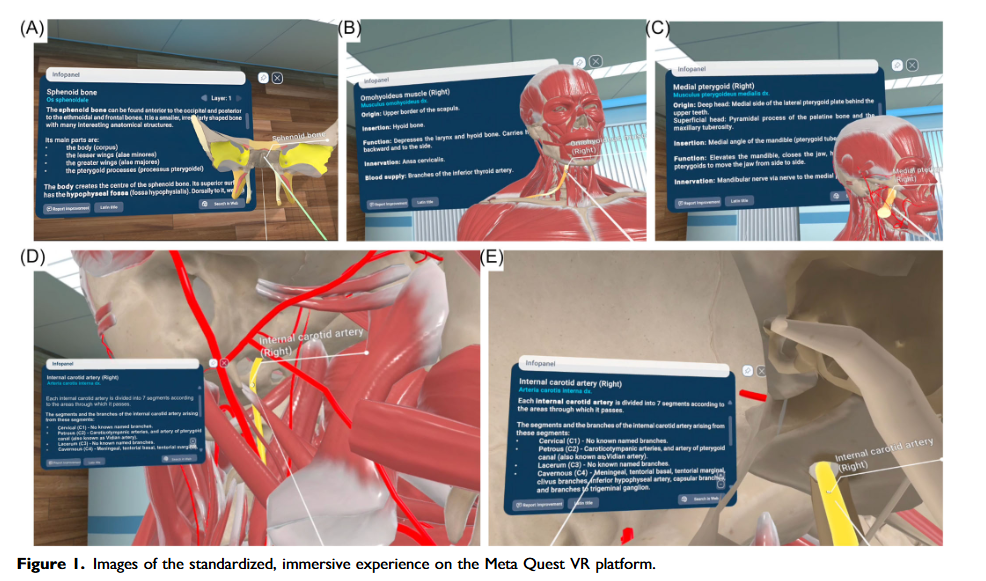
    In the study, “Next Dimension Medical Education: A Pilot Study Exploring Virtual Reality in Head and Neck Anatomy,” the authors evaluated a structured VR learning experience at Louisiana State University Health Shreveport. The educational platform used was Human Anatomy VR for Institutions on Meta Quest 3, with the authors creating a standardized instructional script for each participant.

    The study included 21 medical students who had already completed formal cadaveric anatomy education. Students first completed a multiple-choice quiz, then participated in a guided VR session, and finally completed a post-session quiz. The objective was to evaluate whether the VR intervention could improve understanding of head and neck anatomy, while also measuring confidence, satisfaction, and whether prior exposure to VR or gaming influenced outcomes.

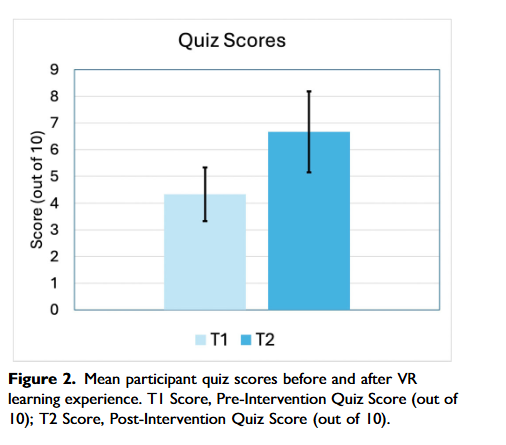
    The findings were impressive. Average quiz scores improved from 4.33 to 6.67 out of 10 after the VR session, an improvement in quiz scores of 54%. Just as importantly, the improvement was consistent regardless of whether students had prior experience with virtual reality or video games. In practical terms, that suggests the platform delivered educational value not only to tech-savvy users, but also to learners coming in with little or no immersive technology background.
    Student perception data also pointed in the same direction. The study reports that 90.48% of participants felt more confident in their head and neck anatomy knowledge after the experience. Students rated the VR session highly for control, sensory immersion, and realism, while reporting minimal distraction or frustration. For institutions evaluating new teaching tools, that combination matters. It is not enough for students to enjoy a platform. The platform also needs to feel intuitive, academically useful, and practical in a real learning environment. This study shows Human Anatomy VR can meet that standard.

    From an academic standpoint, one of the most valuable aspects of this publication is its realism. The students were not beginners to anatomy, and the VR session was not presented as a replacement for traditional teaching. Instead, the study supports a more credible and useful conclusion: Human Anatomy VR can serve as a high-value adjunct to existing anatomy education. That is exactly where many institutions see the greatest opportunity today, using immersive technology to reinforce spatial understanding, improve engagement, and give students access to repeatable 3D exploration outside the limits of conventional lab time.
    For medical schools, nursing programs, and health sciences faculties exploring the role of immersive learning, this study offers a practical signal. Human Anatomy VR is not only capable of creating an engaging experience. It can also contribute to better understanding, stronger confidence, and a more modern anatomy learning environment when integrated thoughtfully into curriculum.

    Study doi: https://doi.org/10.1002/oto2.70217

  • Human Anatomy VR Officially Launches on PlayStation VR2

    Human Anatomy VR Officially Launches on PlayStation VR2

    Human Anatomy VR Now Available on PlayStation VR2: Revolutionizing Anatomical Education with Immersive Learning

    Virtual Medicine is pleased to announce that its flagship educational application, Human Anatomy VR, is now officially available on the PlayStation VR2, bringing immersive anatomical learning to a broader audience through one of the world’s most popular virtual reality ecosystems.

    This launch marks a significant milestone in our mission to democratize access to high-quality anatomical education through extended reality. By leveraging the advanced capabilities of PS VR2, including high-resolution 4K OLED displays and responsive Sense controllers, users can now experience the human body in unprecedented detail and clarity.

    A Platform Built for Education and Innovation

    Human Anatomy VR is a fully interactive 3D anatomical atlas developed for students, educators, medical professionals, and enthusiasts. It allows users to explore the human body with complete spatial freedom, interact with over 13,000 accurate anatomical structures, and learn through guided content, movement animations, and microanatomy models.

    The content is organized into 15 body systems, including the skeletal, muscular, circulatory, nervous, digestive, and reproductive systems. Each anatomical structure is supported by detailed labels and textual descriptions written and reviewed by medical professionals. Users can inspect organs, tissues, and bones layer by layer, remove or isolate structures, and observe muscle movements in real-time animations.

    The platform supports two main content modes: High School and University, making it accessible to a wide range of learners and adaptable to different levels of anatomical knowledge. Whether used in secondary education, medical school, physiotherapy, or patient education, Human Anatomy VR offers a versatile and impactful learning experience.

    PS VR2: Unlocking Performance Potential

    By launching on PS VR2, Human Anatomy VR is now optimized for high-end users equipped with PlayStation hardware. The PS VR2 offers:

    • Dual OLED 2000 x 2040 pixel displays per eye
    • Up to 120 Hz refresh rate for smooth motion
    • Precise head and hand tracking with Sense controllers
    • Advanced haptic feedback and adaptive triggers
    • Eye tracking for enhanced interactivity and control

    These hardware features significantly enhance the visual fidelity and usability of Human Anatomy VR. The result is a smoother, more intuitive, and highly detailed educational experience suitable for individual study or guided learning environments.

    Market Availability and Pricing

    Human Anatomy VR for PS VR2 is now available globally via the PlayStation Store for $29.99 USD. The product is also available on the original PlayStation VR platform and across Meta Quest devices via App Lab.

    The PS VR2 release complements Virtual Medicine’s cross-platform strategy, which aims to make immersive anatomy accessible across consumer, academic, and clinical environments. With users in over 180 countries, the platform is already being used in classrooms, simulation labs, and libraries around the world.

    Transforming Anatomy Education

    The release of Human Anatomy VR on PS VR2 further solidifies Virtual Medicine’s position as a leader in XR-based health education. In recent years, independent studies have shown that use of the platform can improve test results by over 45%, and over 92% of students report increased confidence and understanding of anatomical structures after using the application.

    In addition to formal education, the platform has seen adoption in physical therapy and rehabilitation settings. In one documented case, a patient recovering from spinal issues reported that Human Anatomy VR played a role in helping them visualize the origin of their pain and better understand their treatment process.

    Looking Ahead

    Virtual Medicine continues to invest in product development, with upcoming platform updates including multi-user collaboration, clinical imaging integration, and additional language support to serve a growing international user base.

    The PS VR2 launch represents a critical step forward in the evolution of the Human Anatomy VR platform. As we continue to expand our global footprint, our focus remains on building tools that are educationally effective, scientifically accurate, and technologically advanced.

  • How Penn State University Transformed Anatomy Learning with Virtual Medicine’s Human Anatomy VR

    How Penn State University Transformed Anatomy Learning with Virtual Medicine’s Human Anatomy VR

    Virtual Medicine and Penn State University Enhance Human Anatomy Education with VR Integration

    In Spring 2023, Penn State University’s VAR Edu Lab collaborated with Dr. Lisa Mangel, Assistant Teaching Professor of Biology, to integrate Virtual Medicine’s Human Anatomy VR into her BIOL 164: Human Anatomy and Physiology II course. This initiative aimed to provide students with an immersive learning experience, enhancing their understanding of human anatomy through virtual reality.

    Implementation and Student Engagement

    During the semester, three sections of the course, totaling 60 students, participated in a weekly lab session utilizing the VR technology. Students were divided into groups, with one group using the VR headsets to explore anatomical systems, while others engaged in traditional activities such as examining cadaver specimens. A comprehensive 10-minute tutorial introduced students to the VR program, followed by guided exploration of various anatomical models. In February, students focused on studying arteries and veins, and in April, they reviewed all organ systems covered throughout the semester.

    The integration of VR technology provided students with a dynamic and interactive approach to learning, complementing traditional methods and enhancing their engagement with the course material.

    Outcomes and Future Directions

    The success of this integration led to a total of 140 VR sessions conducted during the semester. Students demonstrated increased proficiency and adaptability in utilizing the VR tools, indicating a positive impact on their learning experience. Building on this success, Dr. Mangel plans to further incorporate Human Anatomy VR in future courses, including innovative projects where students will create and annotate guided VR tours for educational purposes.

    This collaboration between Virtual Medicine and Penn State University exemplifies the potential of virtual reality in transforming anatomy education, offering students an enriched and interactive learning environment.

    For more information on Human Anatomy VR and its applications in educational settings contact our team.